
Why the biggest challenge to artificial intelligence in filmmaking may not be technology — but the industry’s willingness to adapt.
Artificial intelligence may change how films are made.
The harder question is whether the industry is prepared to change with it.
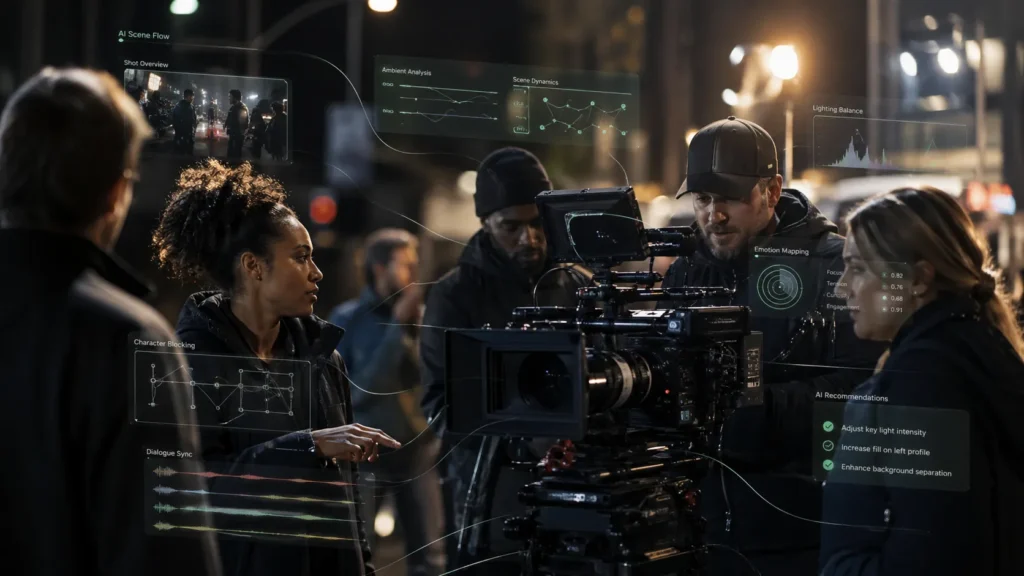
Across media and entertainment, the conversation around AI has largely focused on capability: what the tools can do, how quickly they are improving, and how they might be integrated into development, production, post-production, marketing, and distribution.
But technological capability alone has rarely determined adoption.
Major shifts often stall not because the tools are ineffective, but because institutions struggle to absorb the cultural changes those tools introduce. Artificial intelligence may prove to be no different.
AI Is Moving From Experimentation to Infrastructure
This dynamic is already becoming visible in Hollywood, where questions of authorship, creative identity, labor, and craft tradition sit at the center of filmmaking culture.
Recent developments suggest that the technological phase of AI adoption is accelerating. Netflix is reportedly acquiring InterPositive, the AI-powered filmmaking tools company associated with Ben Affleck, whose stated aim is to reduce the logistical and technical friction that can slow the production process.
The significance of that move is not simply that another media company is experimenting with AI.
The larger signal is that AI is moving closer to the operating infrastructure of filmmaking itself.
For studios and platforms, AI tools may increasingly become part of the production pipeline — supporting scheduling, visualization, post-production, workflow efficiency, and other technical layers that shape how films are made.
But the more important question is not only what AI can streamline.
It is what AI disrupts culturally.
Filmmaking Is Not Just a Workflow
Filmmaking is not merely a technical process. It is a deeply collaborative cultural practice built on trust, authorship, hierarchy, intuition, and craft.
That matters.
A tool that improves efficiency may still meet resistance if it appears to threaten creative judgment, diminish labor, or flatten the human instincts that shape story. In film and television, adoption will not be determined solely by whether AI works. It will be determined by whether the people inside the system believe the technology serves the work rather than replaces the worker.
That distinction is critical.
AI adoption in media will require more than software integration. It will require cultural strategy.
Why This Matters for Independent Filmmakers
For independent filmmakers and rights-holders, these developments carry particular significance.
Large platforms have the resources to test emerging technologies, integrate them into production pipelines, and shape the narrative around their use. Independent creators face a different challenge.
The question will not simply be whether AI tools are available. The question will be how those tools are used in ways that preserve creative integrity, maintain trust with collaborators, and strengthen a project’s market position.
In an independent environment, AI may offer real advantages: faster visualization, leaner production planning, more efficient marketing assets, and better audience analysis. But without thoughtful positioning, it may also raise questions around originality, authorship, and value.
That is where cultural strategy becomes essential.
Global Markets Will Pay Attention
The implications extend beyond the production floor.
In global film markets, projects are evaluated not only on artistic merit, but also on commercial signals, production viability, financing logic, and distribution potential. As AI-assisted production becomes more common, buyers and investors may increasingly look for clarity around how these tools were used.
Was AI used to support production efficiency?
Was it used to replace core creative labor?
Does the use of technology strengthen the project’s market readiness, or create uncertainty around authorship and execution?
These questions will matter because markets are built on confidence.
As with previous technological shifts in cinema — from digital production to streaming distribution — the impact of AI will ultimately be shaped as much by market behavior as by technical capability.
Technology Changes Tools. Culture Determines Adoption.
Artificial intelligence may transform aspects of filmmaking over time, but the industry’s history suggests that capability alone rarely determines what gets adopted.
The intersection of technology, ownership, and market positioning has long shaped the evolution of media financing and distribution. As explored in my recent book NOW PLAYING: From Script to Screen — Web3 Film Funding Playbook, Vol. 1, emerging technologies often reshape not only how projects are produced, but how creative assets are financed, owned, and brought to market.
AI appears to be entering that same structural conversation.
The companies and creators that lead in this era will not simply be those with access to the most advanced tools. They will be the ones that understand how to integrate technology without losing the cultural intelligence that makes storytelling valuable in the first place.
Technology may change filmmaking.
But culture will determine who successfully adapts.
Nea Simone is the Founder of Bespoke Media Marketing, a strategic advisory firm focused on global market positioning for film, television, and intellectual property. She is the author of NOW PLAYING: From Script to Screen — Web3 Film Funding Playbook, Vol. 1.