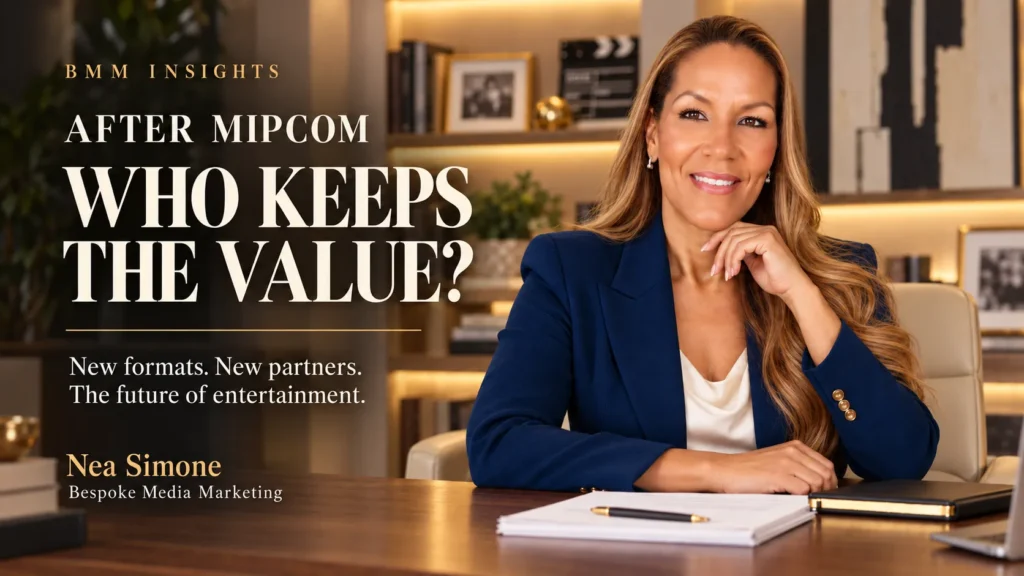

What’s Next in the Future of Entertainment & IP
By Nea Simone | BMM Insights
Returning from MIPCOM 2026 in Cannes, I am considering a question that sits beneath the conversation about new formats, production tools, and distribution platforms:
As entertainment changes, who builds the value, who controls it, and who participates in its growth?
For creators, producers, studios, and rights holders, those questions belong together. A new way to make or distribute content can create opportunity. Whether that opportunity becomes a sustainable business depends on the audience it serves, the economics behind it, and the agreements that support it.
MIPCOM is principally a television and digital content market. Its relevance extends to filmmakers, authors, and other IP owners because the pathways connecting those businesses continue to develop. A book, film, short series, podcast, or character can become the starting point for a broader relationship with audiences and commercial partners.
My reading of this year’s market is that the most useful response is to evaluate how each new model could strengthen a particular property—and where it could introduce costs or obligations the team has not considered.
What MIPCOM’s changing mix of participants signals
MIPCOM’s official 2026 coverage highlighted established entertainment companies alongside creators, brands, agencies, digital platforms, and AI businesses. Its programme included MIP BrandWorks, the MIP AI Entertainment Forum, and a prominent focus on vertical storytelling and microdramas.
The significance, in my view, is the range of potential relationships around a property. A project might seek a broadcaster, an adaptation partner, a brand collaborator, a digital distributor, or support for a specific stage of development.
Those possibilities should sharpen the strategy. They should not produce an increasingly vague request for “partners.”
Before approaching anyone, a team should be able to explain what it needs that partner to make possible, what the partner receives in return, and how the relationship supports the property’s next stage.
Vertical storytelling requires more than shorter episodes
At MIPCOM, executives discussing vertical entertainment emphasized immediate engagement, emotional stakes, and storytelling techniques designed for mobile viewing.
For producers exploring microdramas, that is a development consideration as much as a distribution consideration. The characters need to sustain repeated encounters. Episode endings need to earn a return. The viewing experience needs to work within the format.
The business model needs equal attention. A series supported by advertising has different requirements from one licensed to a platform, funded by a brand, or sold through subscriptions or episode purchases.
A useful assessment would include:
- The cost of producing and delivering the complete series.
- The resources needed to attract viewers and encourage them to return.
- The party responsible for those audience costs.
- The proposed revenue model and the creator’s participation.
- The information available to evaluate performance.
- The rights needed for this version and those available for future development.
Consider a producer developing a thriller. Short episodes could form a complete product, test interest in characters, or introduce a larger story world. Those are different objectives. A test designed to learn about audience response should not quietly become an expensive release campaign without a new decision about resources and purpose.
A microdrama can be valuable on its own terms. It does not need to be treated as an automatic stepping stone to a feature.
AI production tools change feasibility; execution still determines usefulness
MIPCOM’s inaugural AI Entertainment Forum explored applications across the content business. In its opening AI keynote, Utopai Studios presented the technology as a way to support filmmakers and enable projects that traditional production economics might otherwise prevent.
For independent teams, a useful question is which stage of the work could benefit.
An early visual experiment might help a team evaluate tone. A concept sequence might help explain an ambition to a prospective collaborator. A particular workflow might reduce the time needed to explore alternatives.
But an attractive test is not necessarily production-ready material. Character continuity, performance, editing, sound, and the coherence of the finished experience still need attention. Revision time, specialist input, and delivery requirements belong in the budget.
I would assess an AI workflow by asking what usable result it produces, how reliably it produces that result, and what human work is required to finish it. The team should also understand the permissions, approvals, and partner requirements relevant to its intended use.
The opportunity is strongest when the technology helps a creative team make better decisions or execute a clear vision. Generating more material is useful only when the team can turn it into work that serves the project.
Distribution should give each channel a defined role
MIPCOM’s Day Two coverage described YouTube and NBCUniversal discussing a relationship spanning distribution, advertising-supported content, subscription bundles, and international services. BBC Studios also addressed reaching audiences through digital platforms.
These examples invite a strategic question for smaller companies: What role should each channel play in the life of this property?
One channel may introduce the work. Another may support a deeper experience. A screening may connect the project to a community or institution. A licensing relationship may provide access to an audience the creator cannot efficiently reach alone.
That does not mean every property should expand into every format. Each additional activity requires development, management, and money. The team needs to determine whether the proposed extension serves an audience, supports a commercial objective, or simply adds another item to the workload.
Cultural fluency matters within those choices. A platform’s availability in a territory does not establish that a particular community will discover or respond to the work there. Local relationships, language, positioning, and viewing context may affect how the project is introduced.
The strategy should explain how the channels support one another, what the team expects to learn, and where it intends to earn revenue.
Brand partnerships need a clear exchange of value
MIP BrandWorks brought brands and agencies into discussions about developing IP, financing content, and building commercial partnerships.
For producers, this deserves consideration as a potential collaboration model. It also requires clarity about the role being proposed.
A brand could support production, a release campaign, an event, or a particular extension of a property. Those contributions should not be treated as interchangeable. Each carries different expectations about creative involvement, use of the work, and the duration of the relationship.
Before developing a proposal, I would identify the audience connection, the contribution each party will make, the approvals required, and the measures of success. I would also examine whether the collaboration leaves room for the property’s future development.
The creative fit matters. Funding that weakens the audience’s reason to engage can undermine the opportunity both parties hoped to build.
Evaluate the whole opportunity before committing the property
The new models discussed at MIPCOM connect decisions that are sometimes made separately. Format affects production. Production affects financing needs. Distribution affects audience access. Agreements affect future uses and participation.
A useful comparison is therefore broader than the size of an initial payment or the visibility of a platform.
| Decision | What to clarify |
|---|---|
| Audience | Who is likely to respond, and how will they encounter the work? |
| Format | What experience is being created, and why does this form suit it? |
| Economics | Who funds production, delivery, audience acquisition, and ongoing work? |
| Partnership | What does each party contribute, control, and receive? |
| Ownership | Which uses are being granted, and which future opportunities remain available? |
| Performance | What information will show whether the relationship is working? |
These questions help a team identify what it understands, what it is assuming, and where it needs further expertise before committing.
For an author, that could mean evaluating which adaptation opportunity serves the property’s longer life. For a producer, it could mean comparing a larger rights grant with a narrower collaboration. For an investor, it could mean understanding whether a proposed model can be evaluated beyond its novelty.
What to carry into the next market conversation
I would approach the future of film and entertainment with curiosity and selectivity. A promising development deserves investigation. It does not require every project to change direction.
At Bespoke Media Marketing, our work connects audience identification, positioning, readiness, and market opportunity. That includes helping a team determine what its project is ready for and which relationships could move it forward.
Before the next meeting, I would ask three questions:
What is the strongest next use of this property?
Which partner is equipped to support it?
What value must remain available for its creator and stakeholders to participate in what comes next?
Those answers provide a stronger foundation for a market conversation than a list of trends. The aim is to build a creative and commercial path the team understands well enough to pursue.
Explore your project’s next step
Bespoke Media Marketing works with creators, producers, content companies, and rights holders on audience strategy, positioning, market readiness, and international opportunities.
Schedule an introductory conversation to discuss where your project stands and what its next stage may require.
Nea Simone is a New York Times bestselling author, producer, and Founder & CEO of Bespoke Media Marketing. Her work spans original IP development, audience strategy, international market positioning, and partnerships across film, television, and publishing.