
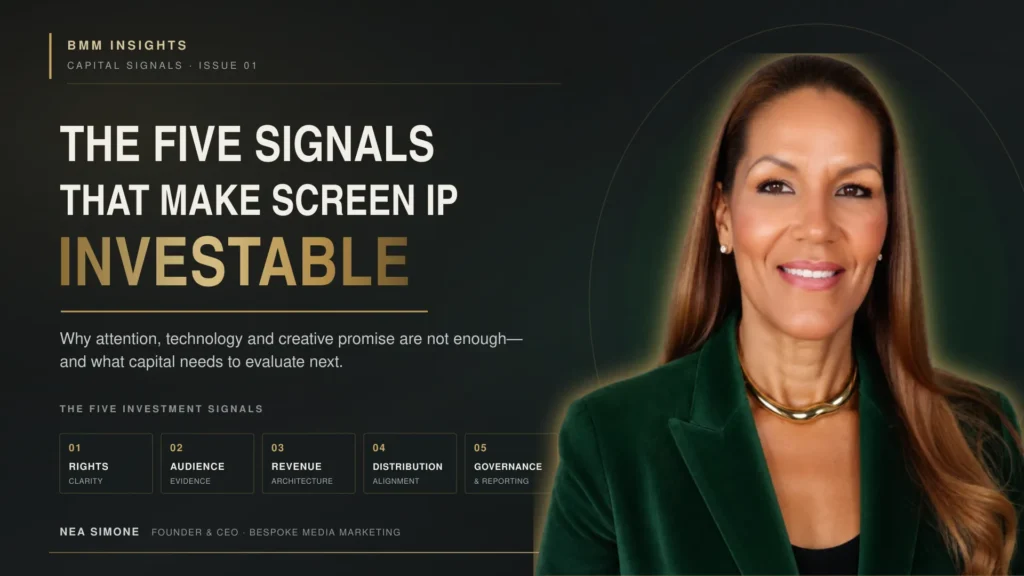

What Film IP Investment Requires
Film IP investment requires more than a compelling story, recognizable talent or early audience attention. For capital evaluating film and television opportunities, investability begins with evidence: clear rights, identifiable audiences, credible revenue architecture, realistic distribution alignment and disciplined governance.
Welcome to the inaugural edition of BMM Insights: Capital Signals, a series examining the intersection of screen IP, ownership, audience, distribution, private capital and emerging financial infrastructure.
I am beginning with a question that sits beneath nearly every conversation about financing film, television and creator-led content:
What transforms a promising project into an opportunity capital can credibly evaluate?
The content industry is not short on compelling ideas. Creators are developing original films, series, vertical dramas, podcasts, digital franchises and audience-powered properties across more formats and platforms than ever before.
Technology is reducing certain production barriers. Creators can build audiences without waiting for traditional gatekeepers. New distribution channels are creating additional ways to reach viewers. Blockchain infrastructure is introducing different approaches to rights, royalties, payments and participation.
Yet innovation does not automatically create investability.
A project may have cultural relevance, strong creative elements or an engaged audience and still lack the structure required for capital to assess its risk, revenue potential and path to recoupment.
That is the investability gap.
Closing it does not require creators to dilute what makes their work distinctive. It requires creative vision, ownership, financing, distribution and monetization to be architected together.
The following five signals provide a practical starting point.
1. Rights Clarity
Before capital can evaluate the potential value of screen IP, it must understand what is actually owned and by whom.
That includes the underlying property, adaptation rights, characters, trademarks, music, life rights, derivative rights and any existing obligations to collaborators, publishers, producers or other parties.
Rights clarity is not the same as surrendering ownership.
Creators can preserve meaningful control while establishing a clean chain of title, documented agreements and a legal structure that allows a project to be financed, licensed and distributed.
The questions are straightforward, even when the answers are not:
- Who controls the underlying IP?
- Which rights are available for development and exploitation?
- Are there territorial, platform or format limitations?
- Can the property extend into sequels, adaptations, merchandise or other revenue-generating expressions?
- Are the agreements sufficiently documented to withstand diligence?
Capital cannot confidently underwrite an asset whose ownership remains uncertain.
2. Audience Evidence
Visibility is useful, but visibility alone is not proof of demand.
Follower counts, impressions and viral moments can attract attention. They do not automatically demonstrate that an audience will watch, subscribe, purchase, attend, recommend or remain engaged with a property over time.
Stronger audience evidence explains:
- Who the audience is
- Why the property matters to that audience
- Where that audience can be reached
- How the audience currently behaves
- What comparable properties suggest about demand
- Whether interest can translate into measurable commercial activity
This is where audience architecture becomes especially important.
A culturally specific project should not have to dilute its identity to appear commercially viable. But its cultural relevance must be translated into a credible market opportunity. Capital needs more than “this audience is underserved.” It needs to understand the audience’s size, behavior, platform preferences, purchasing power and relationship to the proposed format.
The most valuable audience signal is not always the largest one. A smaller, identifiable and highly engaged community may offer a stronger commercial foundation than a broad but passive following.
3. Revenue Architecture
A revenue aspiration is not yet a revenue model.
Statements such as “we will sell the project to a streamer,” “the film will receive worldwide distribution” or “fans will support the property” may describe possible outcomes. They do not explain how revenue will be generated, when it may begin or how investors could be repaid.
A credible revenue architecture identifies the project’s potential income pathways and distinguishes between those that are speculative, probable or contractually supported.
Depending on the property, those pathways might include:
- Licensing and territorial sales
- Platform or broadcaster agreements
- Brand partnerships
- Advertising and sponsorship
- Theatrical, transactional or subscription revenue
- Educational and institutional licensing
- Publishing, merchandise and live experiences
- Format sales and derivative rights
- Digital ownership or audience-participation models
- Tax incentives, grants, presales or minimum guarantees that reduce exposed capital
Not every project needs every revenue stream. Adding more possibilities does not necessarily make an opportunity stronger.
The central questions are:
- Which revenue pathways genuinely fit this property?
- When can each pathway begin producing income?
- What must happen before that revenue becomes available?
- Who participates in the proceeds?
- What is the order of recoupment?
- How does the structure perform under conservativenot merely optimistic—assumptions?
The financing model should reflect the actual commercial life of the project.
4. Distribution Alignment
Distribution should not be treated as the final task after production is complete.
Format, budget, episode length, audience, cast, territory, platform expectations and marketing requirements all influence whether a project can move successfully through the market.
A strong creative concept can become commercially misaligned when it is produced at a cost the likely distribution pathway cannot support, or when its format does not match the way its intended audience consumes content.
Distribution alignment asks:
- Who is the most plausible buyer, platform, distributor or licensing partner?
- What does that market currently acquire?
- Does the format fit the intended channel?
- Can the anticipated revenue support the proposed budget?
- Which territories or audience segments offer the strongest opportunity?
- What materials and evidence will decision-makers require?
- How will the project reach audiences if a traditional acquisition does not occur?
Distribution interest can be a valuable signal, but it is not always a guarantee of revenue or recoupment. The terms, territories, exclusivity, reporting and marketing commitments matter.
Capital therefore needs to understand not simply whether distribution is possible, but whether the distribution strategy supports the investment structure.
5. Governance and Reporting
Creative projects are often discussed in terms of vision and relationships. Capital must also evaluate execution, accountability and control.
Governance explains how decisions will be made, how funds will be managed and how performance will be reported.
Depending on the stage and structure, that may include:
- A dedicated project entity or SPV
- Approved budgets and use-of-funds schedules
- Defined development and production milestones
- Decision rights and approval thresholds
- Financial controls
- Collection-account or revenue-management arrangements
- Recoupment waterfalls
- Investor reporting standards
- Procedures for delays, overruns or material changes
- Clear separation between creative ownership and investor protections
Governance should not be designed solely to remove control from creators. Properly structured, it can protect creators, investors and the long-term value of the IP.
Transparency is not an administrative afterthought. It is part of the investment proposition.
What Web3 Can and Cannot Solve
Blockchain and Web3 infrastructure can strengthen several of these signals.
It can support transparent rights and royalty records, programmable payment structures, cross-border settlement, revenue tracking, digital ownership and new forms of audience participation.
It may also help reduce friction in systems where rights, payments and reporting are currently fragmented.
But technology cannot compensate for unclear ownership, unsupported audience assumptions, weak economics or inadequate governance.
Tokenization does not transform an unstructured project into an investable asset. A digital ledger cannot create demand. A smart contract cannot substitute for a viable distribution strategy.
Technology is most valuable when it strengthens an already credible investment and operating framework.
Investability Is a Design Discipline
As both a creator and an advisor working across media strategy, audience development, ownership and emerging finance, I do not view these five signals as barriers intended to keep creators away from capital.
I view them as design disciplines.
They encourage us to ask the commercial questions early enough to improve the opportunity before costs are fixed, rights become complicated or distribution is treated as an emergency.
They also challenge capital to evaluate new forms of screen IP with greater precision. Creator-led businesses, vertical storytelling, digital franchises and audience-powered properties may not resemble traditional film and television investments. That does not make them inherently uninvestable. It means their economics, assets and performance signals may need to be evaluated differently.
The future of screen investment will not be shaped solely by producing content faster or adopting new technology.
It will be shaped by our ability to connect creative vision to rights clarity, audience evidence, revenue architecture, distribution alignment and accountable execution.
These questions are also informing an invitation-only conversation I am developing for MIPCOM Cannes, bringing together private capital, distribution leaders and entertainment-technology executives to examine what makes next-generation screen IP underwritable and scalable.
For those allocating capital to media and entertainment:
Which of these five signals carries the greatest weight in your evaluation and what is still missing from the framework?
Capital Signals is a BMM Insights series examining the forces shaping screen-IP ownership, investment, distribution and long-term value.