

Every year, producers arrive at global content markets carrying promising projects, polished decks and ambitious expectations.
They attend panels. Exchange cards. Schedule meetings. Share trailers. Post photographs from Cannes.
But market presence is not the same as market positioning.
A badge can put a producer in the building. It cannot clarify a project’s commercial proposition, identify its audience, resolve its rights, strengthen its materials or determine which buyers are genuinely aligned.
That work must begin before the market opens.
In my previous BMM Insight, After Visibility: What Turns a Market Moment Into Momentum?, I examined what must happen after a project gains attention. The same principle applies before a major market: visibility creates an opening, but preparation determines whether that opening can become a meaningful business conversation.
The Market Is Not the Strategy
MIPCOM CANNES is one of the global media and content industry’s most significant meeting points. Buyers, distributors, studios, producers, platforms, financiers and licensing partners gather to discover projects, build relationships and conduct business.
The opportunity is substantial. So is the competition.
Simply placing a project in front of more people does not improve its market potential. A project must be presented to the right people, for the right reason, with a clear understanding of what is available and what outcome the rights holder is seeking.
Effective market representation should be able to answer six fundamental questions:
- What is the project?
- Who is it for?
- Why does it belong in the current marketplace?
- What rights and territories are available?
- What stage has the project reached?
- What specific partnership or transaction is being pursued?
If those answers are unclear, the project may be visible—but it is not yet properly positioned.
What Makes a Project Representable?
Not every strong creative project is immediately ready for market representation. Representability depends on whether the creative vision has been translated into a credible market-facing proposition.
Five areas matter.
1. A Defined Market Proposition
A synopsis tells us what happens in the story. A market proposition explains why the project has value within the international content ecosystem.
That proposition may be driven by genre, audience demand, cultural specificity, talent, format, production access, underlying intellectual property or franchise potential. Often, it is a combination of several factors.
The question is not simply, “Is this a good story?”
The market-facing question is, “Why this project, for this audience, through this format, at this time?”
2. Rights and Delivery Clarity
Buyers cannot meaningfully evaluate a project without understanding what is actually available.
That includes:
- Chain of title and ownership
- Music, archive and underlying rights
- Available territories
- Language versions
- Current production or completion status
- Delivery schedule
- Existing distribution, sales or licensing commitments
Rights uncertainty can stop an otherwise promising conversation before it begins. Clarity gives buyers confidence that the opportunity being presented is real and actionable.
3. Audience Positioning
“Everyone” is not an audience strategy.
A representable project has a defined audience, an identifiable entry point and a reason that viewers will choose it among countless alternatives.
At Bespoke Media Marketing, this is central to our We Find Your Tribe framework. We look beyond broad demographics to consider audience communities, viewing behavior, cultural relevance, market affinities and the pathways through which a project can reach the people most likely to champion it.
Audience positioning does not limit a project’s potential. It gives the market a credible place to begin.
4. Buyer-Ready Materials
A beautiful deck is not necessarily an effective sales tool.
Buyer-facing materials must communicate the project quickly, consistently and commercially. Depending on the project and its stage, that may include:
- A concise pitch deck or sales presentation
- A completed screener, rough cut, trailer or sizzle
- Format and episode information
- Production and delivery status
- Audience positioning
- Relevant comparables
- Talent attachments
- Rights availability
- A clear market ask
Every element should support the same proposition. When the verbal pitch, deck, trailer and stated objective tell different stories, confidence erodes.
5. A Realistic Representation Objective
“Exposure” is not a market objective.
A producer should know whether the project is seeking:
- Worldwide or territorial distribution
- A sales agent
- Acquisition
- Co-production
- Presales
- Format licensing
- Broadcast or streaming placement
- Brand, publishing or licensing partnerships
- Strategic introductions tied to a defined next stage
Those objectives are not interchangeable. Each requires different targets, materials and conversations.
Why Selection Matters
Market representation is not about carrying the largest possible slate into Cannes.
It is about carrying projects that are prepared for the conversations the market can realistically produce.
A curated slate protects the interests of both project owners and potential partners. Buyers need confidence that the projects being introduced have been assessed, that the stated opportunity is credible and that the representative understands why the project may fit their mandate.
That is why BMM reviews projects before accepting them for market representation.
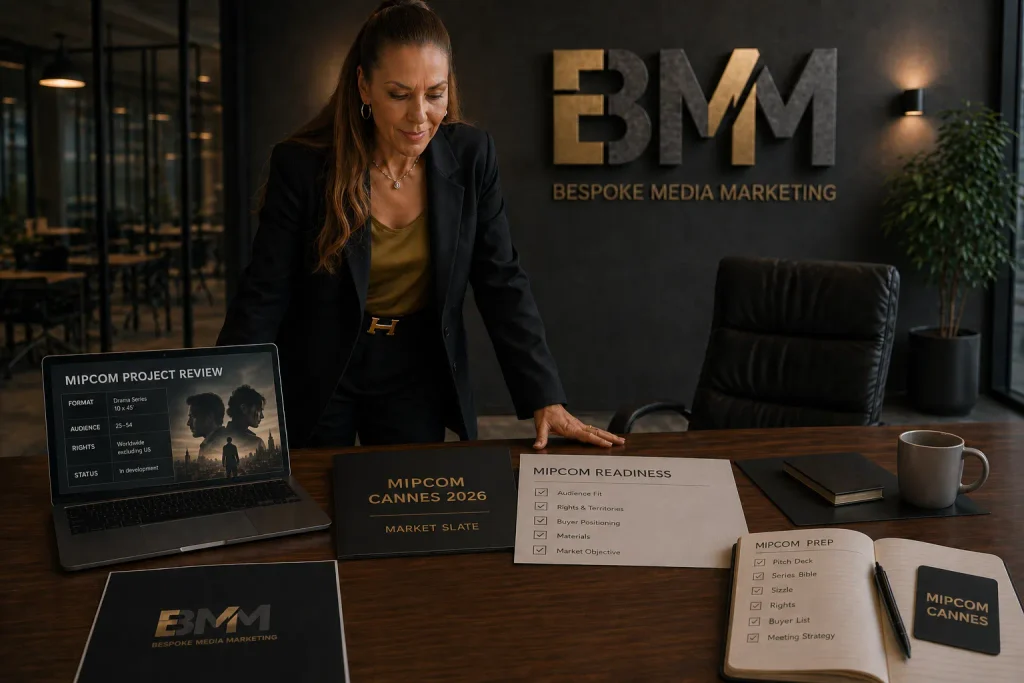
We assess readiness, positioning, audience, available rights, materials and buyer alignment. Where gaps exist, they should be identified before a project is placed in front of the market—not discovered during the meeting.
Market representation is not about carrying the largest slate into the room. It is about carrying projects prepared for the conversations the market can realistically produce.
From Market Access to Global Distribution
BMM has previously represented a project at MIPCOM that went on to secure global distribution.
That outcome did not begin with a chance encounter in Cannes. It began with preparation: understanding the project, clarifying its market value and aligning it with relevant opportunities.
No representative can guarantee a sale. What disciplined representation can do is improve the quality of the opportunity—by ensuring that the project, materials, message, target and ask are working together before the first buyer conversation begins.
Preparing for MIPCOM CANNES 2026
MIPCOM CANNES returns to the Palais des Festivals from October 12–15, 2026, with MIPJUNIOR taking place October 10–11. Official MIPCOM information
Bespoke Media Marketing is currently reviewing a limited number of completed and advanced-stage projects for potential representation, including:
- Feature films
- Television and streaming series
- Documentaries and docuseries
- Animation
- Children’s and family content
- Publishing and other adaptable IP
Projects will be evaluated for market readiness, international positioning, audience clarity, rights availability and realistic buyer alignment before acceptance into the BMM slate.
Because arriving at the market is not the objective.
Arriving prepared to advance the right conversation is.
Is your project ready to be represented at MIPCOM?